Found Sound #6 Ambient Music

It all started as fortuitous encounter with NRP’s excellent radio program entitled, “The 100 most important American musical works of the 20th century.” While scrolling through their selections I came across a composer called Steve Reich who I had recently read about on Pitchfork. During a bit of research on other minimalist composers like I began seeing a lot of references to ambient composers as well. As the names of Eno, Roach, Riley appeared with increasing frequency my curiosity was piqued and I decided to give them a listen. After about three months I am just starting to get my feet wet in the gigantic genre and as with all musical exploration the task has been both daunting and exciting. It has been a pleasure to find something so different from mainstream music even while remaining extremely engaging. And so it is my goal to provide a brief introduction of classic ambient works for those interested and willing to take chance on some exceptionally satisfying music.
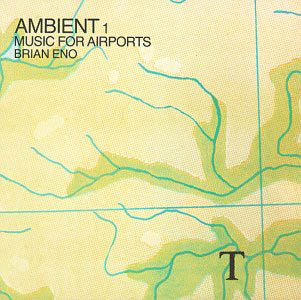 Brian Eno – Music for Airports
Brian Eno's name is synonymous with ambient music. Although he is probably most widely recognized as the acclaimed producer for bands like the Takling Heads, he produced an album in 1978 that defined the ambient genre and remains a classic to this day. “Ambient 1/Music for Airports” is a spectacularly calm album with four movements. The first song entitled 1/1 is beautiful in its simplicity, a piano begins playing a melody which is then looped and added to as the song progresses. 2/2 the fourth track on the album moves slightly away from the first three quieter tracks and builds upon a few synth chords creating a powerfully compelling effect. Eno has said that “Ambient Music must be able to accommodate many levels of listening attention without enforcing one in particular; it must be as ignorable as it is interesting,” and I think this album typifies that sentiment creating something that is both interesting as well as relaxing. Sample this album here.

Aphex Twins – Selected Ambient Works 85-92
For those looking for a more contemporary composer Aphex Twin aka Richard David James is a good bet. His album Selected Ambient Works 85-92, was released in 1992 and was described as a "watershed of ambient music". Rolling Stone wrote of the album, "Aphex Twin expanded way beyond the ambient music of Brian Eno by fusing lush soundscapes with oceanic beats and bass lines". This album is much more listenable for those of us used to more structured music, the presence of the bass and drums provide a stronger movement to the music which can be a welcome change from much of the amorphous ambient out there. This album can be sampled here.
 Steve Reich – Music for 18 Musicians
One of my favorite compositions from Steve Reich entitled, “Music for 18 Musicians” is a classic minimalist piece although it can also be categorized in the ambient genre.
It was written for a cello, violin, two clarinets, four pianos, three marimbas, two xylophones, a metallophone, maracas, and four women's voices. The categorization in ambient is probably due to the structure of the piece which is based around a cycle of eleven chords. A small piece of music is based around each chord, and the piece returns to the original cycle at the end. Even though many of the pieces are looped the diversity of sound is incredible. It at times somber, at others exciting, and always interesting. This composition is amazing and is worth a listen if you have any interest in classical, ambient, minimalist music, in fact I think everyone will enjoy this one. It can be sampled here.
 William Basinski – The Disintegration Loops I-IV
The final ambient music I will highlight is certainly the longest. It also has one of the strangest stories accompanying any piece of music I have ever heard. William Basinski was worried about some analog tape loops he had created in the 1980s and had decided to transfer them to a digital format. What he found while playing the tapes was that because of their age the tapes themselves were literally disintegrating. Each time he would play the loop, bits of iron oxide would fall from the tape and the music on it would sound more fragmented during the next repetition. What makes the story incredible is that he was doing his recording in New York City on September 11, 2001. As he and his friends stood on the top of their building watching the twin towers falling they listened as the tape loops were similarly destroyed. As a result of the disintegration the first loops are the most coherent although it stays listenable right up until the end of the fourth album. Composed primarily of mellow orchestral melodies and synthesizers the pieces are immediately accessible. The individual “songs” range from a couple of minutes up to 65. For a unique listening experience that will leave you awed not only at its incredible coincidence but also its deep beauty check this one out. Sample I-IV here: I, II, III, IV.
I hope you enoy some of this stuff, if there is anything you especially enjoyed or are interested in let me know and I can do a follow up with some more similar artists.
posted by Arctor @ 2:31 PM
1 comments


